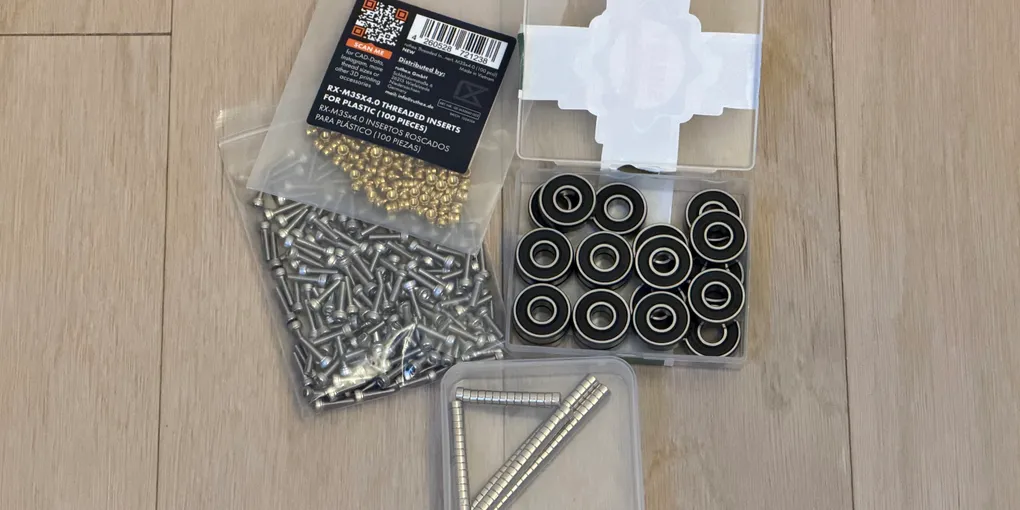
One of the next levels in the 3D printing hobby is working with prints that require additional hardware.When you first come across a model that needs screws, magnets, bearings, or threaded inserts, it can feel frustrating because there are so many different sizes and types to choose from. The good news is that most projects tend to rely on the same handful of standard parts. By keeping a small collection of common hardware on hand, you can save money by buying in bulk and still be able to level up your printing.
Bearings
When a design needs smooth rotation, bearings are usually the answer. The most common is the 608 bearing (8×22×7 mm), the same bearing found in skateboards. You’ll find it in everything from filament rollers and spool holders to robots and fidget toys.
Other useful sizes include:
- 625 bearings (5×16×5 mm)
- 626 bearings (6×19×6 mm)
- 688 bearings (8×16×5 mm)
- LM8UU linear bearings for 8 mm smooth rods
If you’re only buying one size, start with 608s.
Metric Screws and Nuts
The universal fastener of the 3D printing world is the M3 screw. Nearly every printable project uses M3 hardware somewhere.
Recommended sizes to keep on hand:
- M3×6 mm
- M3×8 mm
- M3×10 mm
- M3×12 mm
- M3×16 mm
- M3×20 mm
It’s also worth stocking M3 hex nuts and M3 nyloc nuts. For larger projects, M4 and M5 hardware are common as well.
Heat-Set Threaded Inserts
If you’ve never used heat-set inserts, they are one of the biggest upgrades you can make to printed assemblies. These brass inserts are melted into plastic and provide durable metal threads that can be assembled and disassembled repeatedly.
The most popular size is M3, followed by M4 and M5.
Once you start designing with inserts, you’ll wonder how you ever lived without them.
Magnets
Magnets are the secret ingredient behind many polished-looking prints. They make removable panels, snap-fit lids, tool holders, and modular systems feel professional.
The most common sizes are:
- 6×3 mm
- 8×3 mm
- 10×3 mm
The 6×3 mm neodymium magnet is arguably the 608 bearing of the magnet world—small, inexpensive, and used everywhere.
Rods, Pins, and Shafts
Many moving assemblies benefit from metal shafts rather than printed pivots.
Useful standards include:
- 8 mm smooth rods
- 10 mm smooth rods
- 3 mm dowel pins
- 5 mm dowel pins
These are frequently used for hinges, sliders, and precision alignment.
T-Nuts and Extrusion Hardware
If you build printers, enclosures, or workshop projects, you’ll eventually encounter aluminum extrusion systems such as 2020 and 2040 profiles.
Keep a small assortment of:
- M3 T-nuts
- M4 T-nuts
- M5 T-nuts
They unlock an entire ecosystem of modular projects.
Building Your Starter Hardware Kit
If you’re looking for the shortest possible shopping list, start with:
- 608 bearings
- M3 screws and nuts
- M3 heat-set inserts
- 6×3 mm magnets
- 8 mm smooth rods
- M5 T-nuts
Those six items will support a surprisingly large percentage of printable projects available online.
A small hardware organizer filled with these components will save countless project delays and make it much easier to tackle new designs as you discover them.